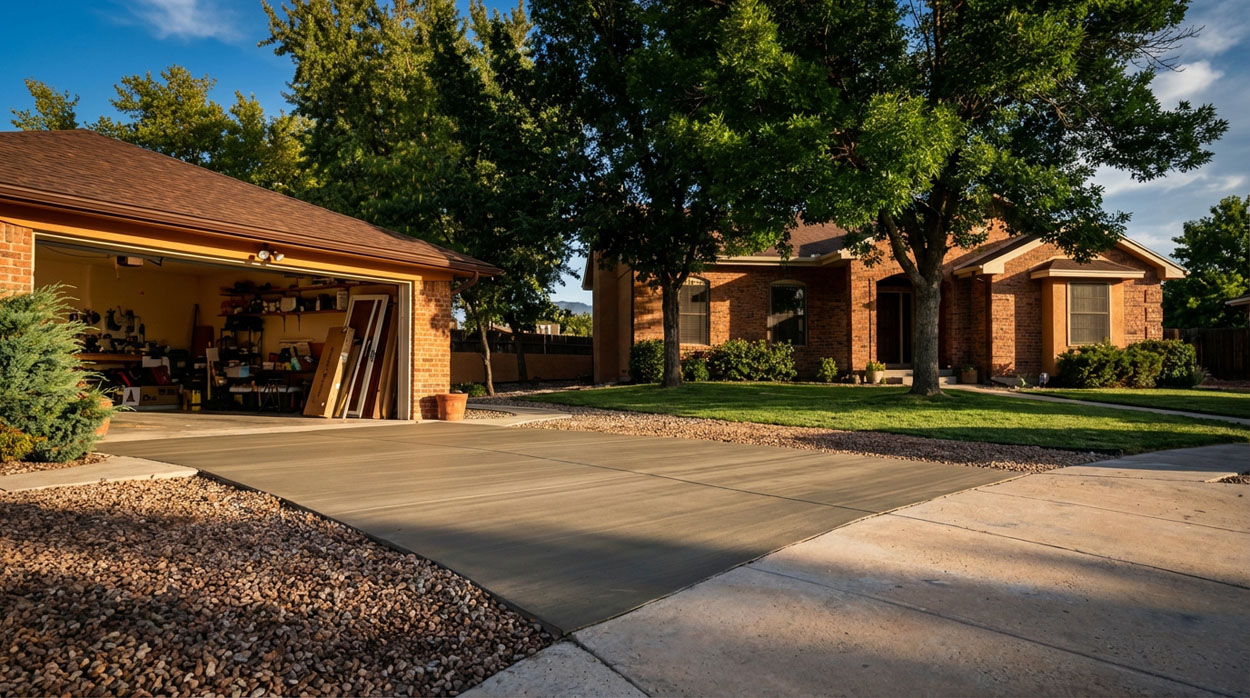
Custom driveways, hillside patios, engineered retaining walls, and slabs for Placitas' unique terrain — rocky substrate, steep grades, and custom homes at 6,000+ feet.
Tell us about your Placitas project — we'll get back to you fast.
Placitas sits on the northern flank of the Sandia Mountains in Sandoval County — a community of roughly 4,400 residents living on properties that range from half-acre lots to multi-acre estates. The median home value exceeds $520,000, the homeownership rate is over 91%, and the median age is 63 — this is an established, affluent community of people who've chosen to live in the mountains and invest in their properties for the long term.
The geology here is what makes Placitas concrete work fundamentally different from anywhere else we serve. The Sandia granite pluton — Precambrian rock over a billion years old — sits at or near the surface throughout the community. Geotechnical borings routinely refuse at 3 feet in decomposed granite. Above the granite, you'll find a mix of Paleozoic limestone, sandstone, and thin layers of alluvium. There is no 8-inch topsoil layer to excavate through before you set forms — you're often working directly on or immediately above rock. Excavation for footings, retaining wall bases, and driveway sub-grades frequently requires pneumatic breaking rather than standard digging.
The terrain compounds the challenge. Within two miles of the community center, elevation changes by nearly 2,000 feet. Hillside lots require cut-and-fill grading, engineered retaining walls, and drainage systems designed for monsoon runoff on steep, rocky slopes. Access roads are narrow — many are unpaved — and concrete truck turnaround space is limited. Every pour in Placitas requires advance planning for site access, pump truck positioning, and material staging that you'd never think about in a flat subdivision. We've developed the experience to handle all of it.
~4,400
Population
5,958–6,500+ ft
Elevation
$520,000–$724,000
Median Home Value
Land grant 1767
Established
Precambrian granite and decomposed granite at shallow depth (often 3 feet or less) — excavation frequently requires pneumatic breaking rather than standard digging
Steep hillside lots with nearly 2,000 feet of elevation change in a 2-mile radius demand engineered retaining walls and precision grading
At 6,000+ feet, lower atmospheric pressure and very low humidity accelerate concrete surface drying, increasing plastic shrinkage cracking risk during finishing
Monsoon rains (1.3–1.4 inches in July–August alone) on steep, rocky terrain create concentrated drainage flows that can undercut concrete if not properly channeled
Narrow, often unpaved access roads limit concrete truck access — pump trucks are frequently required, and site staging must be planned in advance
All properties on private wells and septic systems — slab and driveway placement must respect setback distances from both
Cold-weather conditions are more severe at 6,000+ feet — winter pours require thermal protection when overnight lows reach the low 20s°F
Spring winds averaging 10 mph in April dramatically accelerate surface drying on exposed flatwork
Custom driveways on hillside lots — often long, sloped, and requiring retaining walls along one or both sides
Engineered retaining walls for slope management, erosion control, and terraced outdoor living areas
Hillside patio pours with proper drainage engineering for monsoon runoff on steep grades
Garage and workshop slabs on rocky substrate requiring specialized excavation
Decorative concrete for custom Southwest-style and contemporary mountain homes
Driveway and flatwork replacement on 1980s–2000s homes where the original concrete has been stressed by freeze-thaw and drainage issues
Outdoor living areas, fire pit pads, and portal flatwork designed for Placitas' mountain setting
Properties along the main highway from I-25 eastward toward the mountains. The most accessible part of the community with relatively gentler grades. Homestead Village — the commercial hub with The Merc grocery and local restaurants — anchors this area.
Higher-elevation properties on the mountain's northern flank. Steeper grades, more exposed granite, and more dramatic views. Custom homes here frequently require retaining walls, hillside driveways, and engineered drainage. Access can be challenging for heavy equipment.
Properties along or near Las Huertas Creek — the only year-round stream in the Sandia Range. The canyon environment means more moisture, steeper terrain, and properties nestled into dramatic topography. Drainage engineering is critical for any concrete work in this area.
Properties along the northern edge of the community near BLM land where Placitas' wild horses roam. Larger lots with a more open mesa character transitioning from the mountain foothills. Slightly more accessible terrain but still on rocky substrate.
Some of Placitas' organized subdivisions with HOA governance, though still on large lots with custom homes. These areas have established road access and slightly more standardized lot configurations compared to the fully custom mountain properties.
Residential concrete driveway installation in Rio Rancho, NM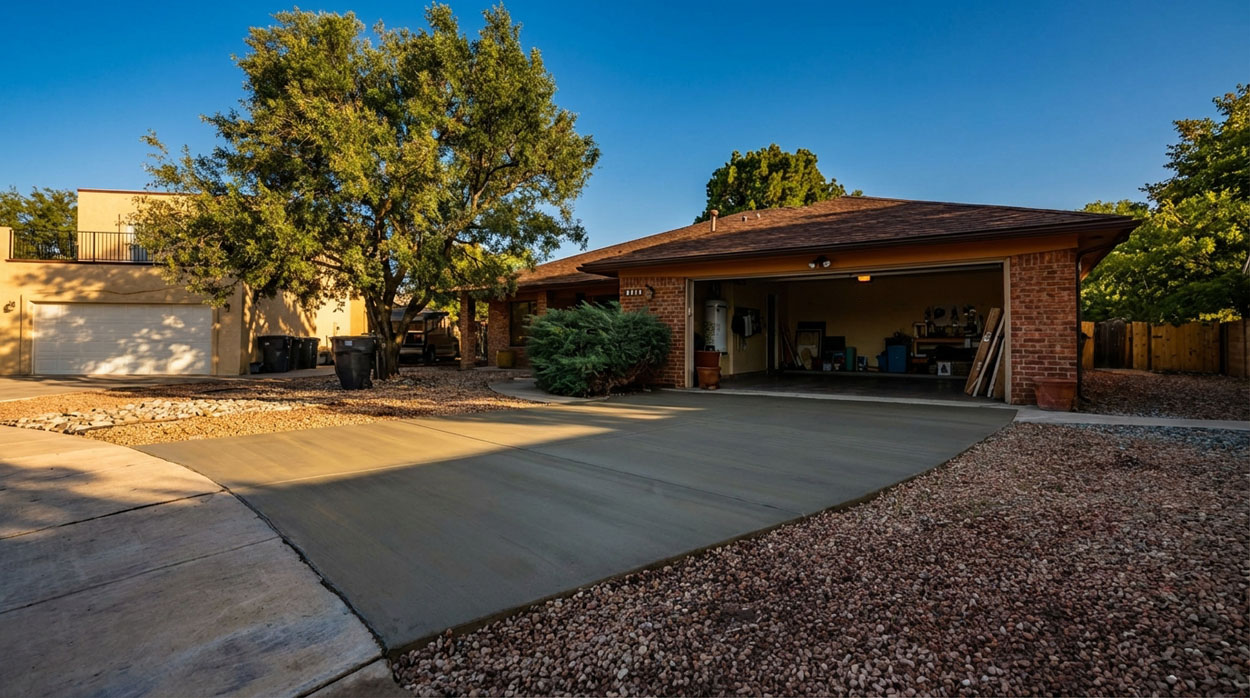 New residential concrete driveway pour in Rio Rancho
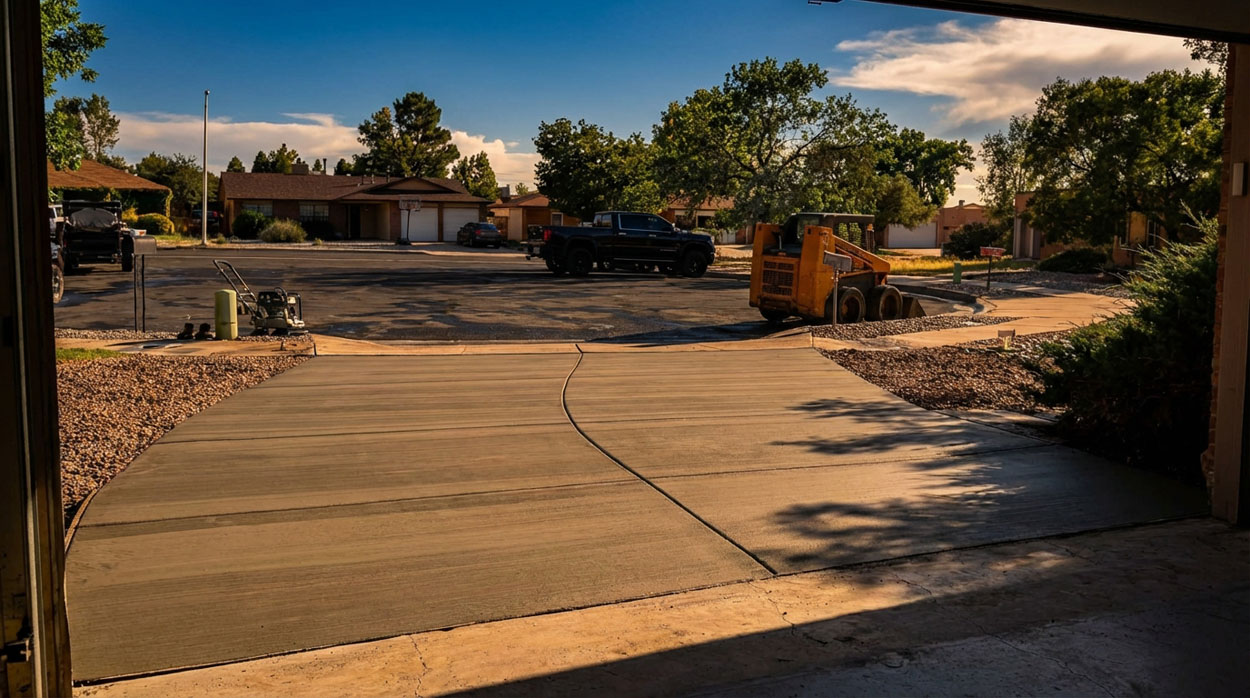 Finished residential concrete driveway in Albuquerque, NM
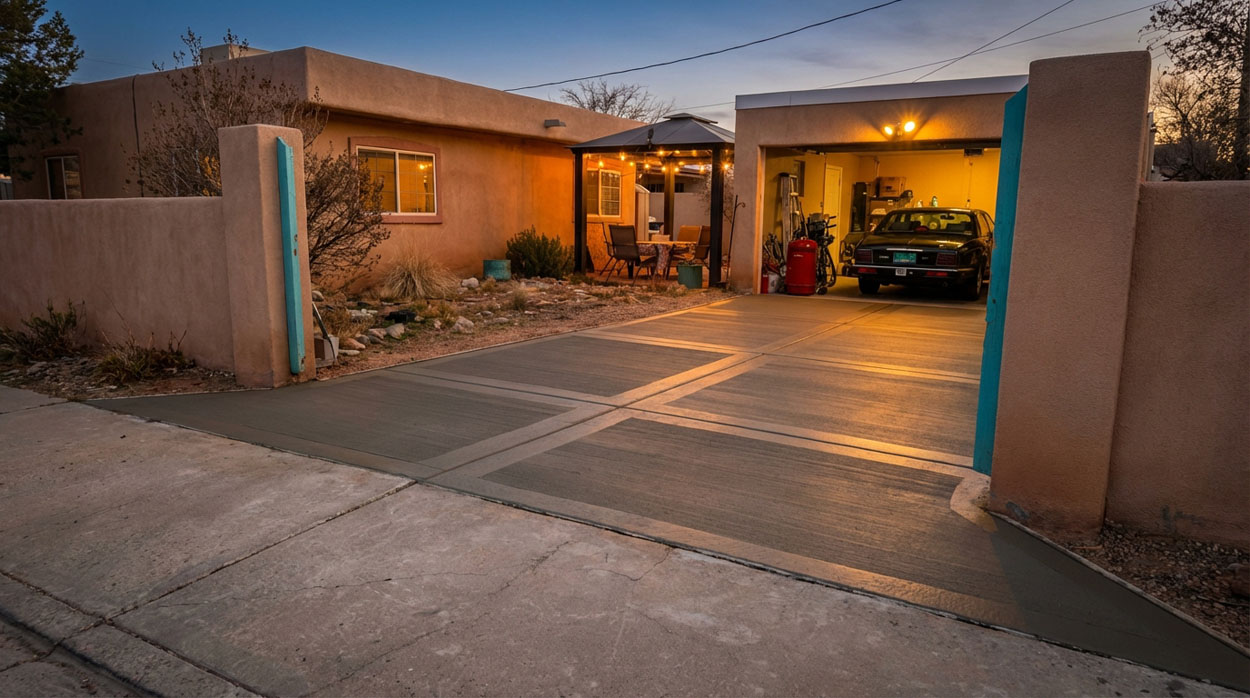 Concrete driveway for southwest-style home in Rio Rancho
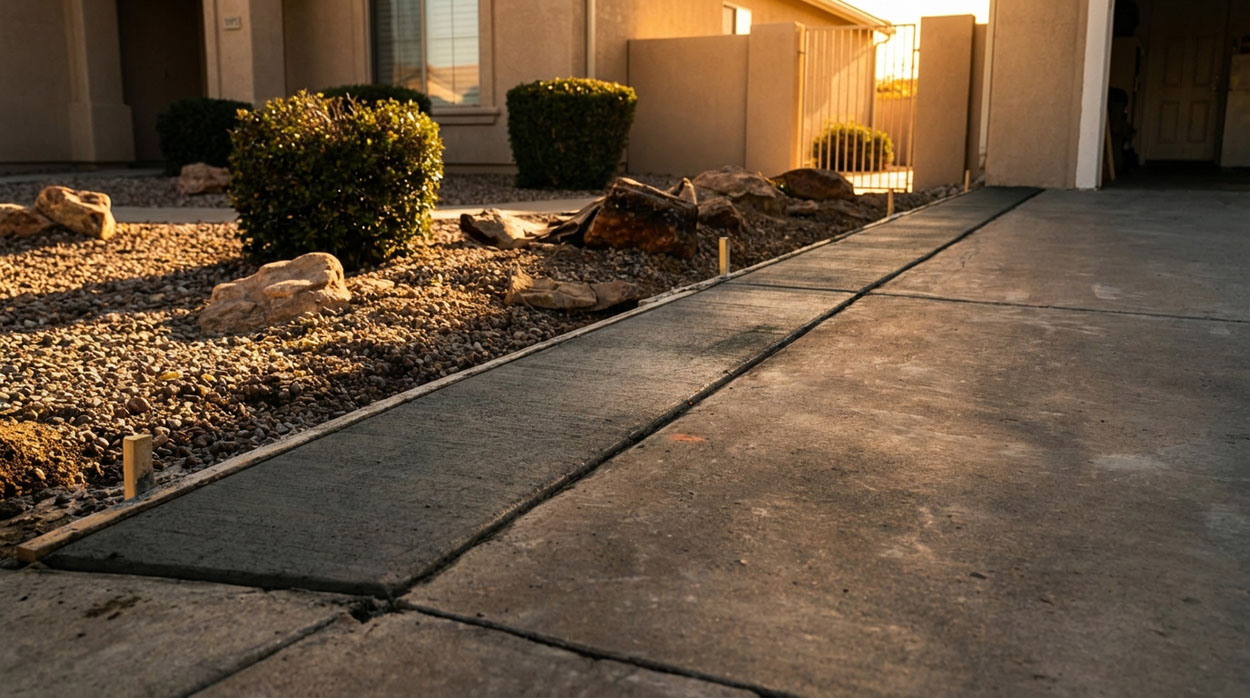 Concrete driveway widening and extension project
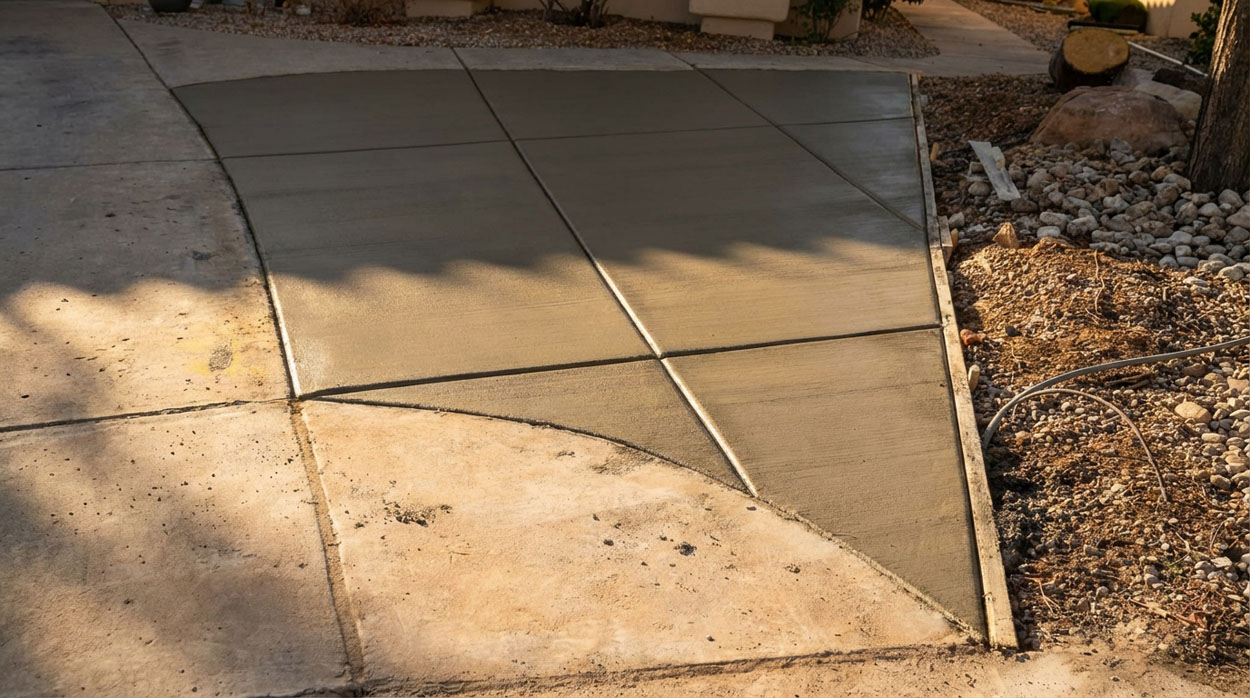 Fresh concrete driveway extension in Rio Rancho, NM
Placitas is the most technically demanding area we serve — and we say that as a compliment to the community. Every project here is custom. There are no production homes, no cookie-cutter driveways, no flat lots where you can just show up and pour. We assess the rock depth, plan the excavation method, engineer the drainage for monsoon runoff on steep terrain, confirm well and septic setbacks, stage equipment on narrow roads, and adjust our concrete mix and curing protocols for the altitude. We've been doing this kind of work in the Sandia foothills for years, and we understand that Placitas homeowners choose to live here precisely because it's not like everywhere else. The concrete work should reflect that same standard.
Three main factors: excavation difficulty (rocky substrate often requires pneumatic breaking rather than standard digging), access challenges (narrow roads may require pump trucks and specialized staging), and terrain complexity (hillside grades require more engineering, more retaining wall work, and more careful drainage design). Every Placitas project involves site-specific planning that doesn't apply on flat suburban lots.
In most cases, yes — but we assess every property's access before scheduling a pour. Some Placitas properties with narrow, unpaved, or steep access roads require a pump truck to deliver concrete from a staging area on a wider road to the pour site. We plan all of this during the estimate visit so there are no surprises on pour day.
At 6,000+ feet, lower atmospheric pressure and very low humidity cause concrete to lose surface moisture faster than at lower elevations. This increases the risk of plastic shrinkage cracking if the surface dries before finishing is complete. We use appropriate water reducers in our mix, apply curing compounds promptly after finishing, and schedule pours to avoid the windiest and hottest parts of the day. Cold-weather pours at altitude also require thermal protection when nighttime temps drop into the low 20s.
Yes — retaining walls are one of our most common Placitas projects. The steep grades and dramatic elevation changes throughout the community make retaining walls essential for slope stabilization, driveway support, terraced outdoor areas, and erosion control. We build engineered CMU block retaining walls designed for the specific loads and drainage conditions on each site.
Placitas sits on Precambrian granite and decomposed granite that's often encountered at 3 feet or less below the surface. For shallow rock, we use pneumatic hammers to break through to the required footing depth. In some cases, rock can actually serve as an excellent bearing surface — it's stable and doesn't shift like clay or sand. We assess rock depth during the estimate and plan our excavation method accordingly.
Placitas is an unincorporated community in Sandoval County. Building permits are issued through New Mexico's Construction Industries Division (CID) after Sandoval County Planning & Zoning confirms zoning compliance. Requirements vary by project scope — a simple patio pad has different permitting requirements than a retaining wall with structural implications. We can help you understand what's required for your specific project.
Call or text (505) 480-7542 for a free estimate on custom driveways, retaining walls, patios, slabs, or decorative concrete for your Placitas property. We specialize in the rocky terrain and hillside conditions that make this community unique.